01The trigger moment
I work as QA at an umrah travel company. Before every departure, the same pattern shows up in the pilgrims' WhatsApp group:
An illustration of the recurring question pattern, not an actual quote
The information actually existed, but it was buried in chat. The product question: if pilgrims could see all of it clearly in one place, what else would they actually need?
02Initial hypotheses
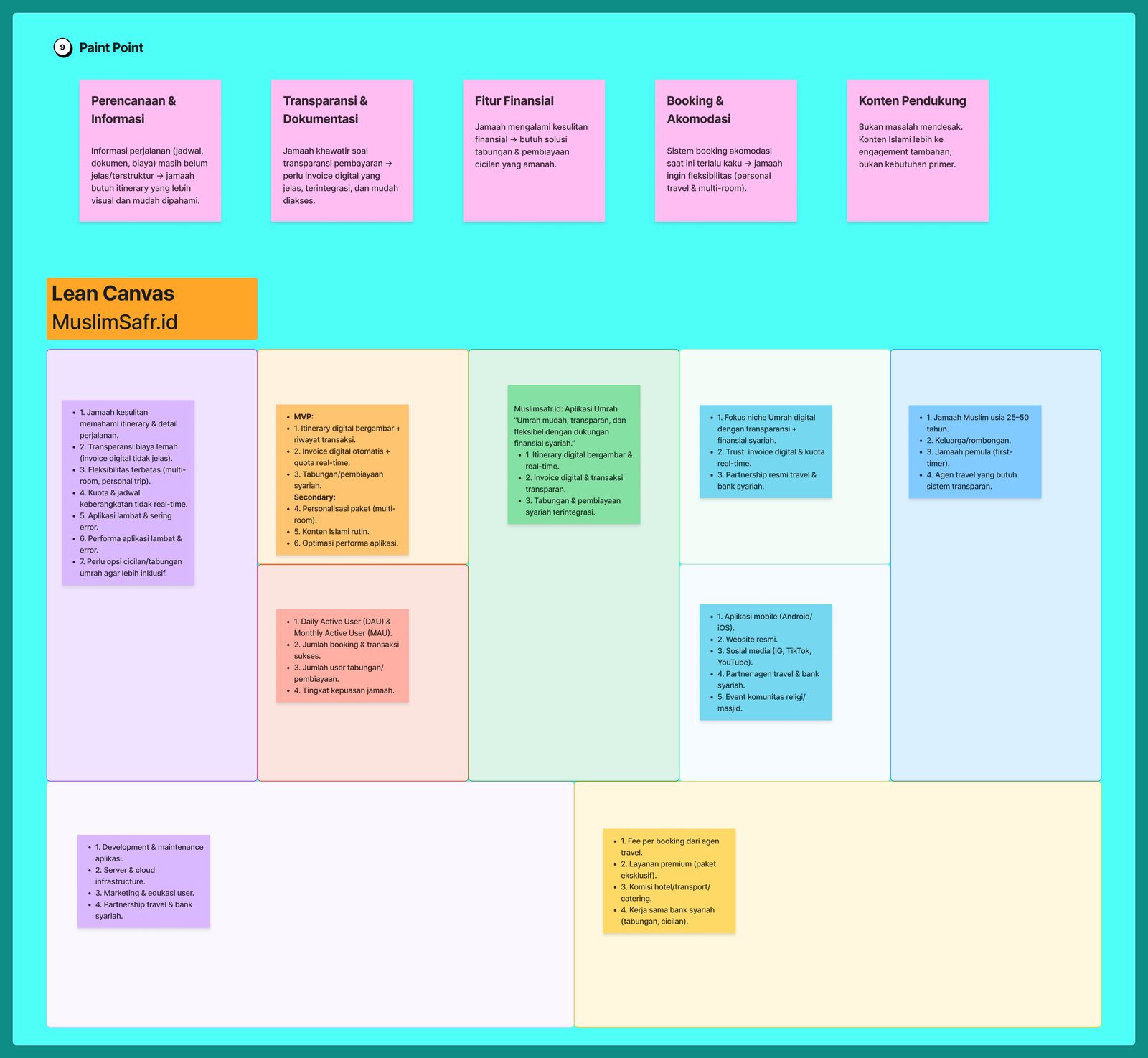
From what I observed in the field, I drafted assumptions that had to be proven first before becoming features:
- Pilgrims struggle to understand the trip plan, so a visual itinerary would help.
- Pilgrims worry about payments, so digital proof of transaction is needed.
- Group packages are too rigid, so pilgrims want flexible room & travel options.
- Cost is a barrier, so umrah savings could open up access.
03Research: testing the hypotheses
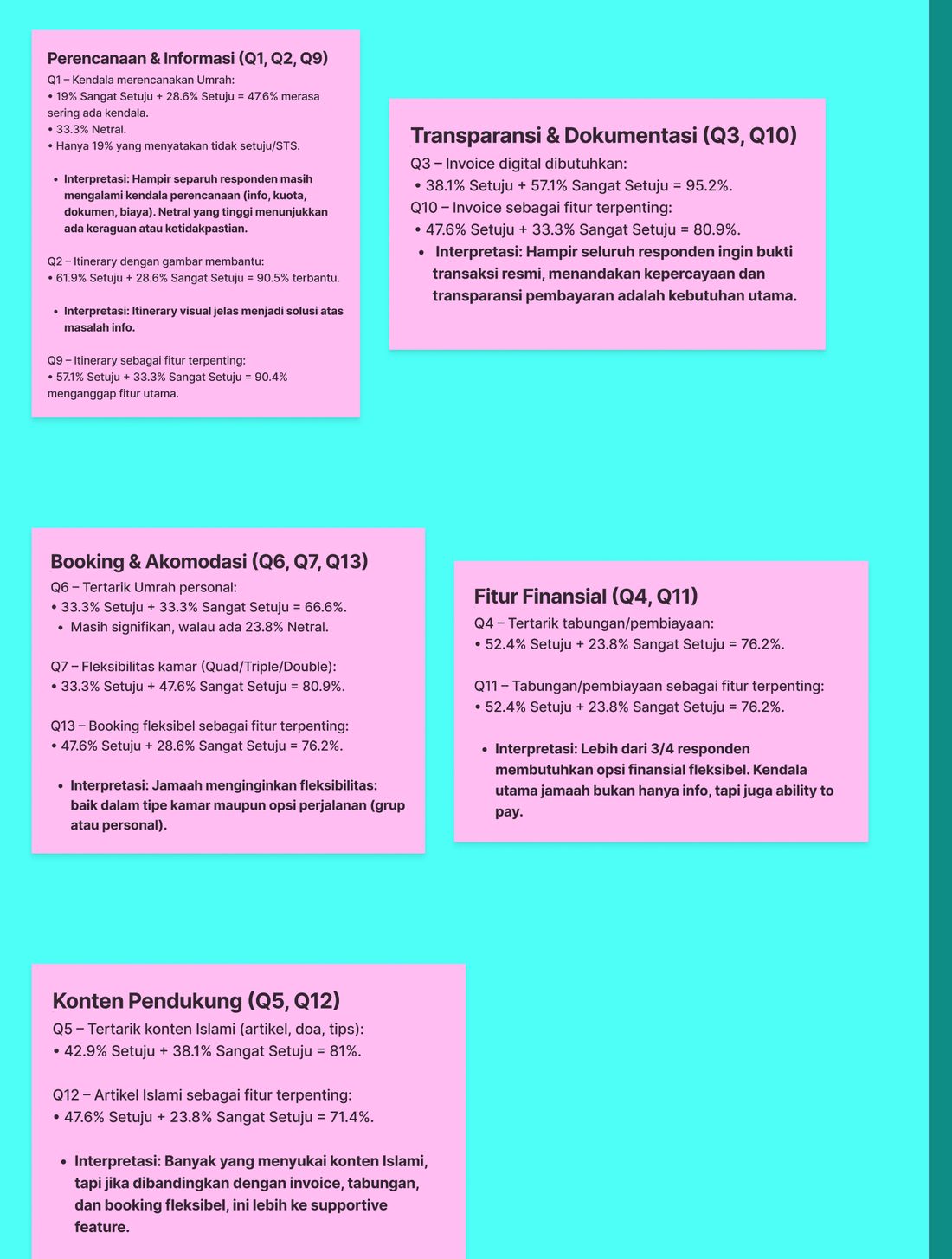
A quantitative Likert-scale survey via Google Form: 21 respondents, 13 statements. Each feature was asked about twice, does it help and is it most important. The second answer separated features people liked from ones they actually needed.
Helpful isn't always most important
% of respondents who Agreed + Strongly Agreed (n = 21)
View data as a table
| Feature | Helpful / interested | Most important |
|---|---|---|
| Visual itinerary | 90.5% (Q2) | 90.4% (Q9) |
| Digital invoice | 95.2% (Q3) | 80.9% (Q10) |
| Flexible booking | 80.9% (Q7) | 76.2% (Q13) |
| Umrah savings | 76.2% (Q4) | 76.2% (Q11) |
| Islamic content | 81.0% (Q5) | 71.4% (Q12) |
| Quota history | 85.7% (Q8) | – |
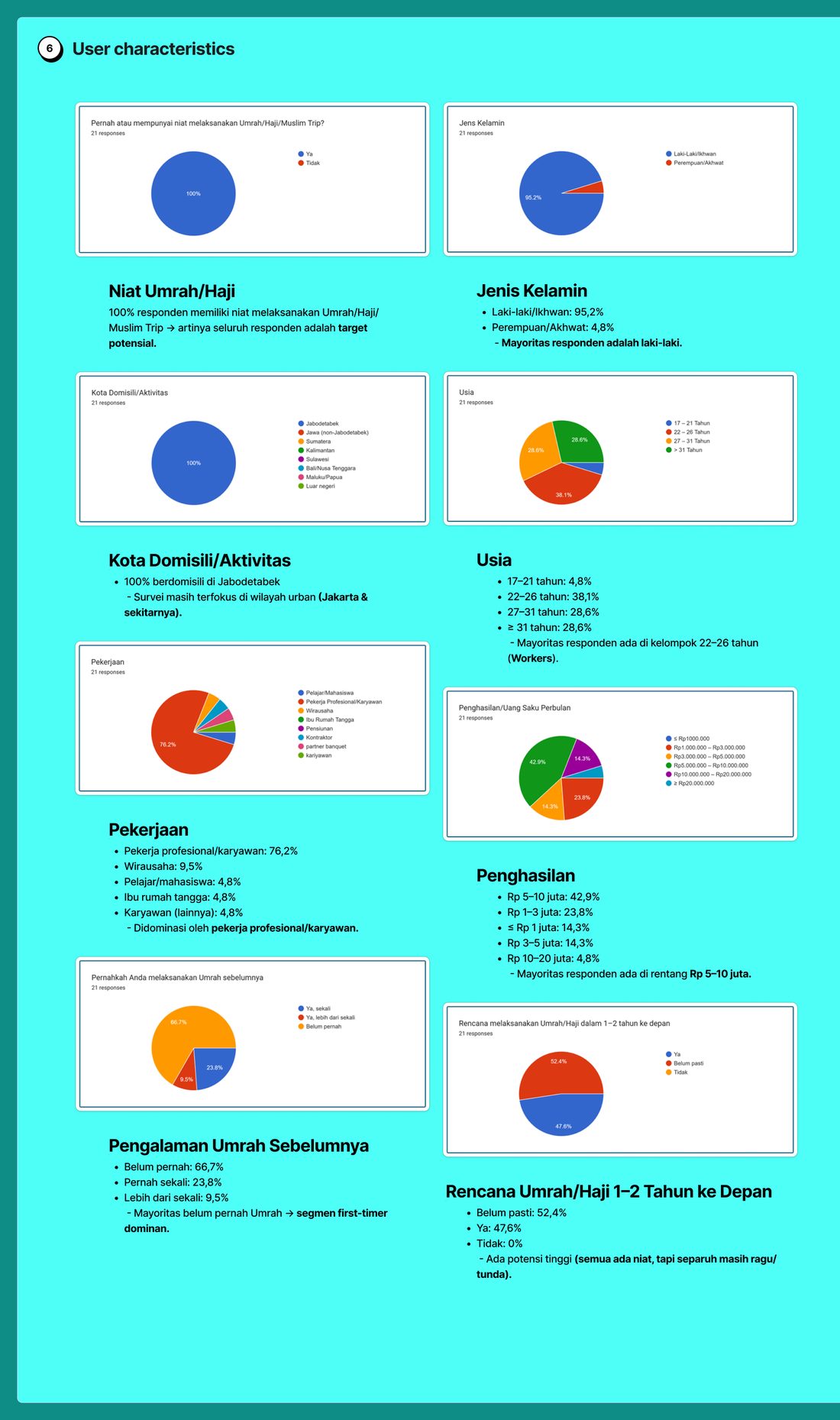
Supporting findings: 66.7% of respondents had never been on umrah, 57% still booked through the travel office, and only 4.8% looked for information through an umrah app. The market is there, but it isn't served digitally yet.
Research limitation. The survey was distributed through a men's sports community in Jakarta, so 95% of respondents were male and all were based in Jabodetabek. Follow-up research needs to reach female pilgrims and those outside Jabodetabek.
View the full research board (FigJam)
04Priority decisions
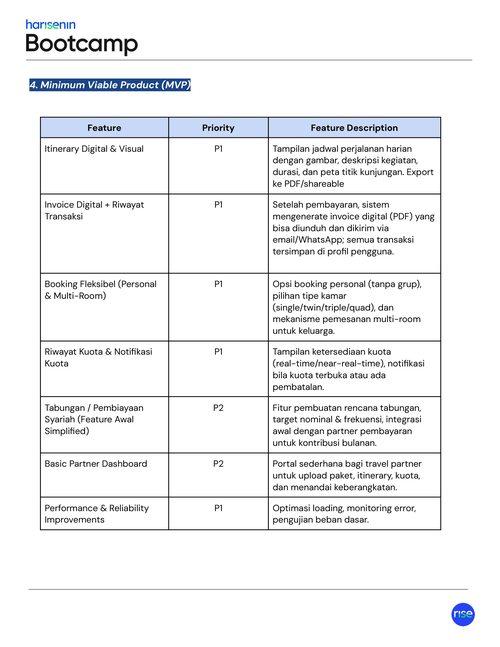
All four hypotheses were confirmed, but not everything could be built at once. Each feature was weighed between need (data) and feasibility (effort & dependencies):
| Feature | Reason | Decision |
|---|---|---|
| Digital & visual itinerary | Highest priority score (90.4%), content already available from travel partners | P1 |
| Digital invoice + history | Highest need (95.2%), core to building trust | P1 |
| Flexible booking | 80.9% want room flexibility | P1 |
| Real-time quota check | 85.7% want to see quota history | P1 |
| Sharia savings | In demand (76.2%), but needs a bank partner & regulatory compliance | P2 |
| Islamic content | Liked (81%), but lowest priority score (71.4%) | Supporting |
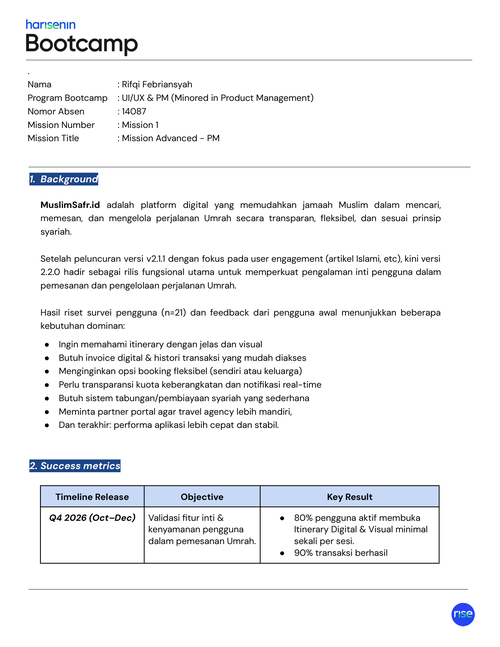
Main trade-off: liked isn't the same as needed. The previous version (v2.1.1) focused on engagement through content. The v2.2.0 release deliberately returned to the core: booking and managing the trip with transparency.
05What the solution looked like
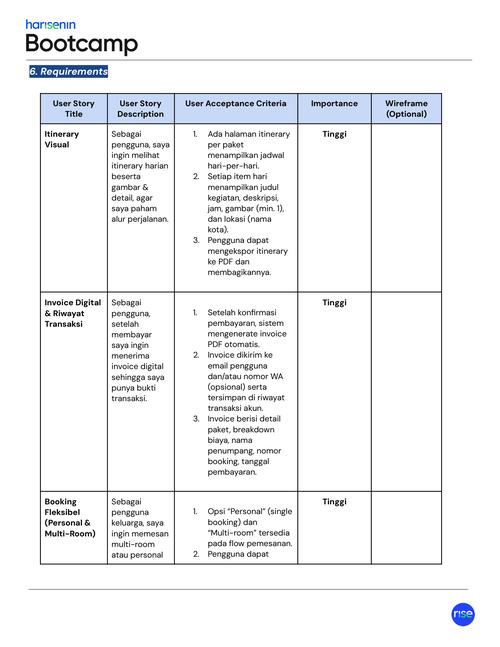
All these decisions went into the PRD v2.2.0: background, assumptions, 6 MVP features, user stories with acceptance criteria, and an explicit out-of-scope list. An example for the main P1 feature:
"As a prospective pilgrim, I want to see the daily itinerary with images & details, so I understand the flow of the trip."
Acceptance criteria
- The itinerary page for each package shows a day-by-day schedule
- Every activity has a title, description, time, at least 1 image, and a location
- The itinerary can be exported to PDF and shared
Screen concept for illustration, not final design.
Roadmap. The P1 feature was built first through to soft launch. P2 only started once the core features were validated.
UT = usability test · Sep 2025 – Jun 2026 (planned)
06Field validation
I ran the digital itinerary manually both before and after writing the PRD. The first version grew out of pilgrim complaints. After the PRD was finished, a more polished version was used by a group of pilgrims for a trip on 14–23 November 2025.
Uniforms, luggage handover, check-in & passport distribution, then fly to Jeddah
Masjid Quba · Date Palm Farm · Mount Uhud. Bring sunglasses, a hat, an umbrella.
Miqat at Bir Ali, then tawaf, sa'i, and tahallul
Split by category: clothing, health, electronics, documents
Why this matters: the core feature was proven to be needed and used in its simplest form before being built. I used the same validate manually first, then build pattern in Hafalan Ikhwan.
07How success is measured
Success metrics in the PRD are split into three phases after launch, each with one objective and a measurable target:
- 80% of active users open the itinerary per session
- 90% of transactions produce an invoice with no errors
- Booking CSAT ≥ 4.3/5
- 200 successful multi-room bookings
- 70% of users understand the total price without contacting CS
- Booking duration −30%
- 150 savings plans created
- 20% make a first contribution
- 10 active travel partners
08Reflection
- Align planning documents from the start. In the first draft, the timelines in the PRD, roadmap, and release train weren't consistent, and P2 was still scheduled in parallel with P1. The roadmap above is the cleaned-up version.
- Add qualitative research. A survey tells you what, interviews tell you why, especially for the savings feature, which is financially sensitive.
- Expand the sample to female pilgrims and those outside Jabodetabek, then test the itinerary prototype directly with pilgrims before development.
09Full PRD
The complete PRD v2.2.0 — background, success metrics, assumptions, the 6 MVP features, roadmap links, user stories with acceptance criteria, and the out-of-scope list. Scroll through all 8 pages below.
Couldn't load the embedded viewer — open the PDF directly →